{talib} provides fast R bindings to the TA-Lib C library for OHLCV data: technical indicators, candlestick pattern recognition, rolling-window utilities, and composable financial charts. It is designed for researchers, analysts, and quant developers who need technical-analysis features in R without building a heavy dependency stack. Core computations are executed in C through .Call(), while charting support is available through optional {plotly} and {ggplot2} integrations.1
The API covers 150+ TA-Lib-backed functions across momentum, overlap, volatility, volume, cycle, price-transform, rolling-statistics, and candlestick-pattern families, including 61 candlestick pattern detectors.
Why {talib}?
| Need | {talib} |
|---|---|
| Technical indicators | TA-Lib-backed moving averages, momentum, volatility, volume, cycle, and overlap studies |
| Candlestick patterns | Built-in Japanese candlestick pattern recognition |
| OHLCV workflows | Works directly with open, high, low, close, and volume columns |
| Performance | Computation delegated to C routines through .Call()
|
| Charts | Composable financial charts with optional plotly and ggplot2 support |
Installation2
Install the release version from CRAN:
install.packages("talib")Install the development version from GitHub:
pak::pak("serkor1/ta-lib-R")Quick start
All functions provide S3 methods for <xts>, <data.frame>, <matrix>, and—where applicable—<vector> inputs. The general convention is simple: the output uses the same container type as the input.
## calculate the
## relative strength index
relative_strength_index <- talib::RSI(
    talib::GOOGL
)

## check class equivalence
inherits(
    relative_strength_index,
    class(talib::GOOGL)
)
#> [1] TRUE

## display results
tail(
    relative_strength_index
)
#>                 RSI
#> 2021-12-22 53.47421
#> 2021-12-23 54.45979
#> 2021-12-27 56.42226
#> 2021-12-28 53.37121
#> 2021-12-29 53.28979
#> 2021-12-30 52.07450
Indicator outputs preserve input length, which keeps results aligned with the original OHLCV rows.
## combine multiple
## indicators
features <- cbind(
    talib::relative_strength_index(talib::GOOGL),
    talib::bollinger_bands(talib::GOOGL),
    talib::engulfing(talib::GOOGL)
)

tail(features)
#>                 RSI UpperBand MiddleBand LowerBand CDLENGULFING
#> 2021-12-22 53.47421  149.1432   144.4920  139.8408            0
#> 2021-12-23 54.45979  149.2513   144.5318  139.8124            0
#> 2021-12-27 56.42226  149.6263   144.8180  140.0097            0
#> 2021-12-28 53.37121  149.7444   144.8758  140.0072           -1
#> 2021-12-29 53.28979  149.8398   145.1137  140.3876            0
#> 2021-12-30 52.07450  149.7308   145.3711  141.0115           -1
Charting
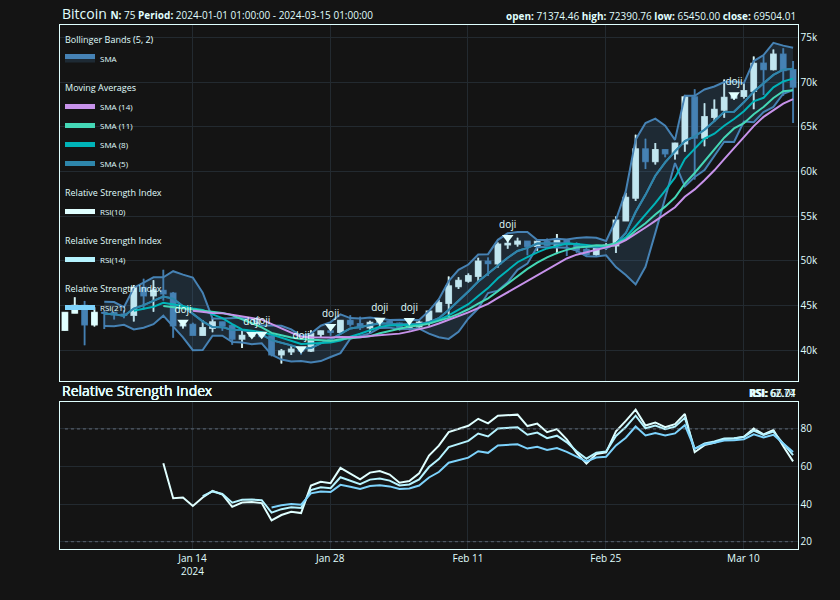
{talib} comes with a composable charting API built on two core functions: indicator() and chart()—both functions are built on model.frame for maximum flexibility:
## subset data and
## store as 'GOOGL'
GOOGL <- talib::GOOGL[1:75, ]

## construct chart in a brace block
## alternatively use `|>`
{
    ## initialize main chart
    talib::chart(
        x     = GOOGL,
        title = "Alphabet Inc."
    )

    ## add Bollinger Bands to
    ## the existing chart
    talib::indicator(
        talib::BBANDS
    )

    ## add Simple Moving Averages (SMA)
    ## to the chart in a loop
    for (timePeriod in seq(5, 15, by = 3)) {
        talib::indicator(
            talib::SMA,
            timePeriod = timePeriod
        )
    }

    ## similar subchart indicators
    ## like the Relative Strength Index
    ## can be grouped to avoid repeated
    ## subpanels
    talib::indicator(
        talib::RSI(timePeriod = 10),
        talib::RSI(timePeriod = 14),
        talib::RSI(timePeriod = 21)
    )

    ## identify Doji patterns
    ## and add them to the chart
    talib::indicator(
        talib::doji
    )
}
Implementation: {talib} vs upstream (TA-Lib Core)
Functions use descriptive snake_case names; each is aliased to its TA-Lib shorthand for compatibility with the broader ecosystem, and to a camelCase name for consistency across R’s finance ecosystem:
| Category | TA-Lib (C) | {talib} | {talib} alias | {talib} camelCase alias |
|---|---|---|---|---|
| Overlap Studies | TA_BBANDS() |
bollinger_bands() |
BBANDS() |
bollingerBands() |
| Momentum Indicators | TA_CCI() |
commodity_channel_index() |
CCI() |
commodityChannelIndex() |
| Volume Indicators | TA_OBV() |
on_balance_volume() |
OBV() |
onBalanceVolume() |
| Volatility Indicators | TA_ATR() |
average_true_range() |
ATR() |
averageTrueRange() |
| Price Transform | TA_AVGPRICE() |
average_price() |
AVGPRICE() |
averagePrice() |
| Cycle Indicators | TA_HT_SINE() |
sine_wave() |
HT_SINE() |
sineWave() |
| Pattern Recognition | TA_CDLHANGINGMAN() |
hanging_man() |
CDLHANGINGMAN() |
hangingMan() |
Interface: R vs Python
The main difference between the R and Python interfaces is how OHLCV series are passed into each indicator function. Below is an example of identifying Doji patterns in R and Python.
In Python, each series is passed independently:
import numpy as np
import talib

o = np.array([1, 1, 1, 1, 1, 1, 1, 1, 1, 1, 1], dtype=float)
h = np.array([2, 2, 2, 2, 2, 2, 2, 2, 2, 2, 2], dtype=float)
l = np.array([1, 1, 1, 1, 1, 1, 1, 1, 1, 1, 1], dtype=float)
c = np.array([2, 2, 2, 2, 2, 2, 2, 2, 2, 2, 1], dtype=float)

print(
    talib.CDLDOJI(o, h, l, c)
)
In R the series are passed as a tabular container:
ohlc <- data.frame(
    open  = c(1, 1, 1, 1, 1, 1, 1, 1, 1, 1, 1),
    high  = c(2, 2, 2, 2, 2, 2, 2, 2, 2, 2, 2),
    low   = c(1, 1, 1, 1, 1, 1, 1, 1, 1, 1, 1),
    close = c(2, 2, 2, 2, 2, 2, 2, 2, 2, 2, 1)
)

talib::CDLDOJI(
    ohlc
)
All default series arguments are handled internally, and the R interface is therefore higher-level: users pass one OHLC container rather than manually splitting the series.
Contributing and cloning
Contributions are welcome. For non-trivial changes, please open an issue first to discuss the proposed design, API impact, and testing approach.
This repository vendors TA-Lib as a Git submodule. Clone the repository with submodules enabled:
If you already cloned the repository without submodules, initialize them with:
Most indicator wrappers, helper functions, documentation fragments, and unit tests are generated from the scripts in codegen/. The charting interface is maintained separately.
Common development tasks are exposed through Make targets:
See CONTRIBUTING.md for the full development workflow.
Code of Conduct
Please note that {talib} is released with a Contributor Code of Conduct. By contributing to this project, you agree to abide by its terms.